Architects for Peace's editorials
LATEST EDITORIALS...

25 June 2012

The Divide

“A wide divergence between two groups, typically producing tension or hostility.” 


On the matter of ‘divide’ (noun), the Oxford Dictionary is succinct. The divide also happens to be the fledgling premise put forward by arch-peace founder Dr Beatriz Maturana, of a planned conference that is currently germinating in our midst...possibly to be a trans-continental affair, spanning Melbourne, Australia and Santiago, Chile, where Beatriz is now based.

23 May 2011

The Detention Spectacle

While an architecture student, I took a subject that involved the then recently de-commissioned Melbourne City Watch House. Part of the Russell Street 'jail precinct' in the city centre, the building was a temporary holding centre for prisoners awaiting trial or spending a night in the lock-up for trouble-making of some sort. Unlike the Old Melbourne Gaol next door, which closed its doors in 1929, the watch house was in operation right up until 1994. The knowledge of this was sobering, given the grim – bordering on archaic – conditions inside. Chilly, narrow stone-walled cells empty of all but a bench and an exposed toilet pan in a corner had been shared by whoever happened to be locked up for the night – as recently as the 90's! The property was owned by RMIT University, and, in conjunction with the National Trust, possibilities for its potential adaptive re-use as a museum – from a site of extreme seclusion from the outside world into a site of public spectacle – were being explored. As a historic place stripped of its former function, but occupying prime real estate, there was a perceived need for it to become something else – and a well-intentioned push to open it up the public, allowing its story to be told. At the same time there was a recognition of the gravity of the place and what was understood to be the often traumatic experience of confinement, and to try to interpret and communicate something of this to hypothetical visitors, without diminishing or trivialising the space and its memories in the process.

17 June 2008

Reflections on Brazil

The following editorial is a reflection on my time spent in Brazil in 2007, during which 
I was a university intern, attended the Architecture Biennale and participated in a regional conference of architecture students.

The Sao Paolo Architecture Biennale is held in alternation with the more famous and longer-established Art Biennale. In 2007, I attended along with students and staff from the Universidade Estadual de Maringa at the close of my internship in the Department of Architecture and Urbanism. The theme of the exhibition was “Architecture: the public and the private”.

The Biennale takes place at the Parque de Ibirapuera, naturally inside a building designed by the darling of the Brazilian architecture scene, Oscar Niemeyer. As an architect travelling in Brazil, it’s easy to fall into a sort of Niemeyer pilgrimage. Admittedly, that name composed a significant proportion of the sum total of my Brazilian architecture knowledge prior to my trip, and my expectations were not wholly confounded. It seems that almost every city that takes itself seriously has a piece of Niemeyer; a determined advocate of social justice whose vision has splintered and congealed in monuments scattered all over the country. After celebrating his 100th birthday in December last year, he is apparently not only alive and kicking but still coherent in television interviews and indeed still designing; certainly a force to be reckoned with. Yet I found something unsatisfying about seeing his work up close; something that began to dawn on me somewhere between his eponymous museum in the form of a giant eye in Curitiba and the space-ship like Museo de Niteroi perched spectacularly – if somewhat incongruously – on a rocky coastal outcrop just outside of Rio de Janeiro. True, the manipulation of concrete into breath-taking, curvaceous forms is no mean technical feat. What bothered me was that, while the architect has waxed lyrical for years about social reform, his buildings remain surprisingly tight-lipped on the subject.

Still, in a country so fraught with contradiction, it is perhaps unsurprising that Niemeyer has seduced the nation with his rhetoric but failed to deliver the goods. It is very difficult to generalise about Brazil; the size of the country and indigenous as well as colonial influences have produced distinct regional differences that manifest themselves in speech, music and cultural traditions. Perhaps the only thing that can be safely asserted is the intrinsic presence of contradiction. As an intern at the UEM, I became aware early on that the university system itself is predicated on contradiction. In theory, public universities offer free education. Fantastic, I thought. In reality, all prospective students must sit a comprehensive entrance exam (at each university applied for), whether applying for biology or theatre arts. Passing is really only feasible for young people who have attended private secondary schools or who paid for one or more post-high school years at specialised preparatory schools, meaning that wealthier families end up with free education, while those who can’t afford the upfront preparation costs only have the option of the ongoing costs of the private system. Among public university teaching staff, dissatisfaction with low salaries is widespread, and regular strikes place students at risk of missing semesters.

Not surprising then that university reform should be one of the items on the agenda of the students involved in the FENEA – National Federation of Students of Architecture. The culture of student meetings bringing together universities throughout the country is not exclusive to architecture, but it certainly seems that architecture students have plenty to say. For a start, the name of the course is Architecture AND Urbanism – and this encompasses landscape architecture, urban design, planning and interior design – suggesting that the relationship between the design of buildings and their wider context is established from the outset. Back home, the tendency towards specialisation has generated a myriad of independent built environment disciplines – which can then be dressed up as streamlining services and providing opportunities for collaboration and multi-disciplinary engagement, but risk operating in isolation from one another. The FENEA holds annual conferences at regional, national and Latin America wide levels during which projects are presented, workshops held and relevant issues debated. They are run entirely by students. There is a big element of fun involved; Brazilians like to celebrate and there’s no doubt that drinking sessions and parties motivate plenty of students to take part. This seems to fuel scepticism among students who aren’t involved, with rumours of corruption and mis-use of funds within the student movement. Even so, it’s clear that the organisation required to make these events happen is formidable and more impressive given the already sizeable workload that is the lot of the average architecture student. The organising students are committed to the content of the conferences, politically-minded, articulate and passionate. At the very least, the conferences foster connections between students from different universities and different regions; something that seems to have been strangely absent from my own education, where there was barely a sense of a student community within my own faculty, let alone interaction with other schools in Melbourne.

Student activism is not limited to the FENEA. The non-profit-organisation Um Teto Para Meu Pais (A Shelter for my Country), which has spread from Chile throughout Latin America, started out in Brazil in 2007 almost entirely under the direction of volunteer students from various disciplines at the University of Sao Paolo. The premise is relatively simple: a three stage plan to assist struggling communities in regional and urban areas. Stage 1: constructing a new house for one family, based on a relatively crude model – 5 x 8 metre, one room, pre-fab timber box with two wooden shutters and a door. Stage 2: implementation of training and development programs within the community. Stage 3: construction of long-term, custom-designed complex based on identified community needs.

Currently only stage 1 has been executed in Brazil. The scale of the pre-fab model is such that one can be erected by a team of 4-5 unskilled volunteers in a weekend. Male family members usually help too. It’s hard work. The volunteers stay overnight in the community and alcohol is banned, so unlike the FENEA meetings, there’s no partying incentive. Social consciousness
Signs of this active student scene were disappointingly scarce at the 2007 Biennale. With the exception of a tertiary design competition and some research projects, the host nation’s contribution to the exhibition seemed to focus largely on the professional world. There was of course the ubiquitous section devoted to old Oscar’s imminent birthday, but the rest of the exhibition came across feeling something more like a commercial expo than a critical representation of contemporary architecture and urbanism in Brazil. It is true that the Brazilian government of late has embraced the spirit of progress and perhaps this was simply reflected in the skyscrapers and resorts on public display, while the political and social awareness I had seen demonstrated by student groups must have constituted the ‘private’ part of the theme (so private as to be, in fact, almost invisible). I found myself asking what happened in the transition from the academic to professional world? Was there an organised professional body to provide the platform for dialogue that is available to the student population?

Discussions with students seemed to suggest not, and there was certainly no evidence of such a thing at the Biennale. Perhaps there is more at stake for practicing architects in the real world than for 20-somethings who can argue about the social capacity of the architect during the day then samba the night away. Certainly that seems to be the case here in Australia, where professional reputations and client retention can discourage political involvement.

So Niemeyer, now 100, continues to churn out concrete masterpieces in the name of the greater good, but will he be around for the 2009 Biennale? One wonders who will take the baton from the radical idealist who brought Brazilian architecture to the world stage. It’s unlikely that there is another master designer waiting in the wings, but there are many passionate voices willing to fill the void; to act on unrealised social values and perhaps transcend the concrete legacy that Brazil continues to present to the world.

Meanwhile, back home, a student congress is scheduled to take place in Canberra in 2009. It is being promoted as the first such event to take place since 1981. 28 years is a long time between drinks. Let’s hope there’s a Brazilian on the organising team.

Eleanor Chapman
Architects for Peace, June 2008

18 December 2006

Melbourne’s housing crisis

Melbourne’s housing crisis – Practicing outside property lines
December 2006, by Eleanor Chapman

In September of this year I was fortunate enough to hear Guatemalan-born architect Teddy Cruz speak on the subject of Border Urbanisms. His practice, Estudio Teddy Cruz, is confronted with a particular border condition, informed by its location in the US city of San Diego, sister city of Tijuana on the Mexican side of the border; the two separated by a 20 minute drive and a world of difference. This border territory represents an intense collision of disparate cultures and social classes, and at first glance may appear to have limited relevance for the situation here in Australia. The border zone that divides our nation from the world at large is embarrassingly large and abstract; our government’s indignation at the trickle of occasional boatloads of asylum seekers seeming a pathetic gripe alongside the swelling human tide that pounds daily against the Mexican side of the Tijuana-San Diego border, while the other side retreats. However, Cruz’s border crossings are beginning to uncover other, less visible borders, with both universal and particular significance to the problems of Melbourne’s urban condition.

The first suggestion of common ground is a cosmetic one: outer suburban San Diego is not so removed in appearance from the bloated, homogeneous housing developments enabling Melbourne’s steady spread outwards. At home, the buoyant spirit of the suburban dream that envelops these developments and drives their sales pitch belies a bleak reality for prospective home buyers. While inner city property values climb, lower income earners are increasingly shut out of the market; pushed further to the periphery without access to adequate infrastructure or public transport systems. It is being touted as a housing affordability crisis. In fact the real crisis is playing out in the lives of those who are not even in the market for the tiny and diminishing proportion of housing stock available to low income earners. This crisis manifests in the length of the waiting list for public housing vacancies (close to 35,000 in 2003
[1]). The prospect of accommodating public housing needs in city fringe developments threatens to marginalize these groups further and is not a viable option; affordable housing is needed in inner city areas close to public transport, support services and job opportunities. Unfortunately affordable housing strategies implemented in Melbourne’s recent history on the fringes of the CBD – those sombre grey towers bearing mournful witness to the tragedy of dashed Modernist dreams – have only served to reinforce the divide between the haves and have-nots. In the words of Ed David from the Office of Housing, they are ‘concentrations of disadvantage’[2]; islands cut adrift from the street within a surrounding no-man’s land of ‘public’ space and viewed with a mixture of suspicion and fear by the wider community. In inner city areas, as redeveloped apartments and infill housing increasingly appropriate the leftover industrial fabric that once represented the working class, opposite ends of the means spectrum are ironically brought into closer physical proximity, while the rift between these groups yawns ever wider. Local governments are proud of this social diversity, and their planning policies cite the importance of maintaining this character, as if it reflected an interactive community spanning the breadth of the means spectrum. In reality, cafes, quirky boutiques and bars crowd in, regenerating ‘activity centres’ for the enjoyment of yuppie apartment-dwellers, while the remains of past public housing policy stagnate. The rapid urban transformation taking place in inner-urban Melbourne is geared towards fostering not social interactions, but divisions.
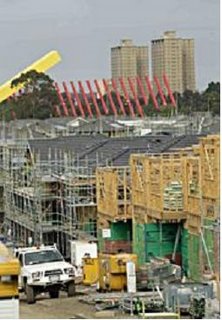


Kensington housing commission flats overlook construction works at the 2006 Commonwealth Games village site. Source: DHS website


It is divisions of this nature, arising because or in spite of the intentions of planning authorities, that architects and other building professionals have an ethical and professional responsibility to address. Cruz is critical of the reluctance of architecture as a profession to engage with political boundaries, and advocates the idea of ‘urbanism beyond the property line[3]’. It is hardly surprising that a profession already beset by self-doubt is loath to venture onto the political stage. Our claim to a legitimate place in the building industry is tenuous at best, and difficult to communicate, limiting our core client base to an elite group with the means and inclination to place a monetary value on design. Added to this, a splintering of specialist interior is squeezing the architecture profession’s market share, landscape and project management streams and the rise of design-build firms. Architects have always performed a curious marionette’s dance of compromise – charged with other people’s dreams, and the task of sustaining them amid a myriad of additional constraints also beyond our control - budget, site selection, planning regulations. Adding political involvement to the top of this precarious pile might seem akin to balancing in the middle of a wobbly bridge above piranha-infested rapids, and choosing to stand on one leg. Yet while we are talking about boundaries, it is precisely this imaginary line that Cruz has identified as ‘the gap between social responsibility and artistic expression’[4] that has to be crossed. An isolated, excusive practice of architecture that fails to challenge the accepted limits of its operation will remain impotent and its reach limited. Instead of imagining ourselves to be at the mercy of planning codes, we should be looking to question and subvert them. Cruz speaks of ‘injecting’ ambiguity into seemingly rigid regulations; in fact this ambiguity may already exist – in strategies that refer vaguely to the creation of public/private interfaces and the transformation of ‘hard’ urban edges – but it needs to be interpreted and exploited. Doing this requires a good understanding of planning strategies and appreciation of their intent, to be kept in sight once the discussion sinks to the level of setbacks and car parking requirements. It is not always the intentions at fault, but their execution. For all the frustrations of dealing with shortsighted planning authorities and ill-conceived guidelines, I would suggest – perhaps naively as a recent graduate – that there is potential for building professionals to channel the energy already invested in this area into seeking out a more active and politically engaged role and opportunities to begin a dialogue between authorities and communities.

Where does Melbourne’s housing crisis come into this? Ironically, the failures of past affordable housing models and their contribution to the current bleak situation could present the most promising opportunities for stakeholders in the public housing sector. The need for new models is now widely apparent, and there are significant obstacles to their development; not least of which is the stigma attached to public housing. Critical to success, then, are efforts to cross boundaries, to establish a meaningful dialogue that addresses both a development’s immediate physical context and its place within the bigger picture. The architect’s role in this scene is neither social engineer nor subservient window dresser, but mediates between these worlds and opens the doors to other players. One recent project, the redevelopment of the Derby St commission flats in Kensington as a mixture of public and private housing stock, sought to integrate affordable housing units into new private developments. The development is ongoing and it is too soon to gauge its success, but as noteworthy as the outcome is the process, involving collaboration between state government, a private developer, non profit organisations and architects, and lengthy consultation with existing tenants and locals
[5]. A similar process took place in the VicUrban/Devine Homes/Try Youth venture of December 2004 that engaged architects to design an affordable home and unemployed youths to build it. Perhaps collaborative processes of this kind, crossing discipline boundaries and encouraging dialogue as a means of generating unknown outcomes, rather than a tool introduced belatedly to justify the project and placate stakeholders, can lead to a genuine architecture of participation. The alternative is to hang back on the periphery, becoming increasingly irrelevant and incapable of positively influencing the urban environment. A willingness among architects to cross political and disciplinary lines could be just what is needed to stretch the limits that currently dictate our professional and social engagement with the built environment.
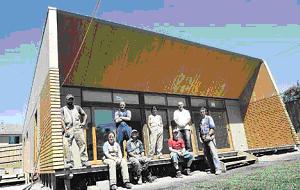
Community house project,
Live Load Architecture/VicUrban/DHS
Source: The Age
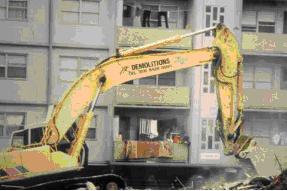


Demolition of existing public housing stock,
Kensington
Source: Angela Baileyio


[1] Chris Middendorp, ‘This is the real housing crisis’, 1/11/03, The Age
[2] Ed David, lecture at Re:Housing conference, 8/10/06, Capitol Theatre
[3] Quote from Teddy Cruz in Solnit, R. ‘Non-conforming uses: Architect Teddy Cruz at the borders of tomorrow’
[4] Ibid.
[5] Kensington Estate Redevelopment Social Impact Study, prepared by Swinburne University of Technology for the DHS, August 2004